Internal:PODM 3D
- Read PODM3D paper✔
- Install all PODM3D libraries✔
- Compile PODM3D code✔
- Restructure repository of PODM3D based on Software engineering standards✔
- Execute PODM3D✔
- Read Guaranteed Quality Tetrahedral Delaunay Meshing for Medical Images paper (Sect. 9)
- Create an extra Rule which will be a user-defined sizingFunction that gets a tetrahedron when all rules are met✔
- Create UML diagrams to understand the code and the Meshing Procedure in general✔
- Create a list of functions that need to be modified to implement the extra Rule ✔
- Modify the created list (Extra Rule sizing Function list) of functions✔
- Create a test sizing function to understand if modifications have been done correctly✔
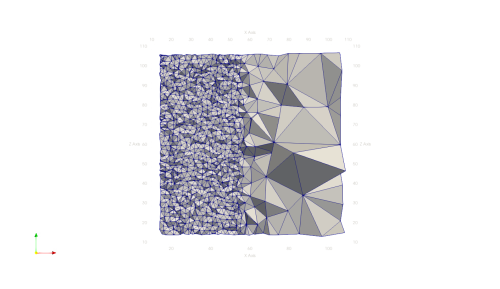
- The test sizing function is
bool checkSizingFunction(double coordinatesOfTetrahedron**)
{
    double volume = volume(coordinatesOfTetrahedron);
    double* baryCenter = baryCenter(coordinatesOfTetrahedron)

    // if x axis <= 55 and volume of tetrahedron > 10
    if (baryCenter[0] <= 55 && volume > 10)
       return true;
    else
       return false
}
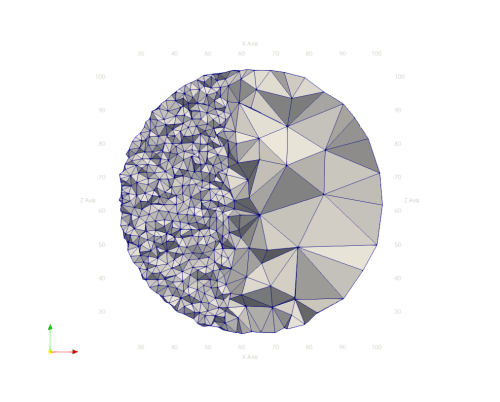
- Podm Result of Cube image with Dimensions 110x110x110 and Sphere image with radius = 55, volume grading on and δ=10
- Cube:
- Sphere:
- Cube:
- The test sizing function is
- Implement Adaptivity in 3D inside sizingFunction using Christos Code:
- Implement Adaptivity in 3D✔
- Podm Result of Gagic Data image with volume grading on and δ=6, minimum Volume Size = 0.5, limit = 0.1
- 2D (Triangle):
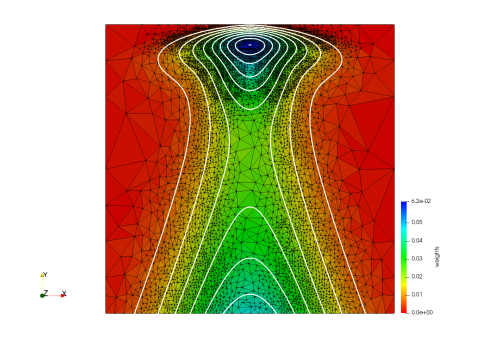 (Done by Christos)
- 3D (PODM):
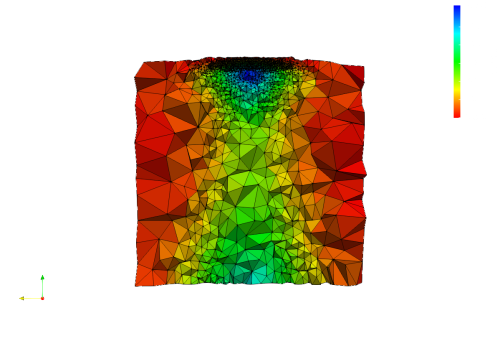 (Done with Christos)
- 2D (Triangle):
- Handle cases with negative weight (rescale them)
- Test Adaptivity with extra images (cases) from Gagik Gavalian
- Create Sizing Function pointer
- Create an animated Meshing Process✔
- Produce the meshes for the Meshing Process video and the January report✔
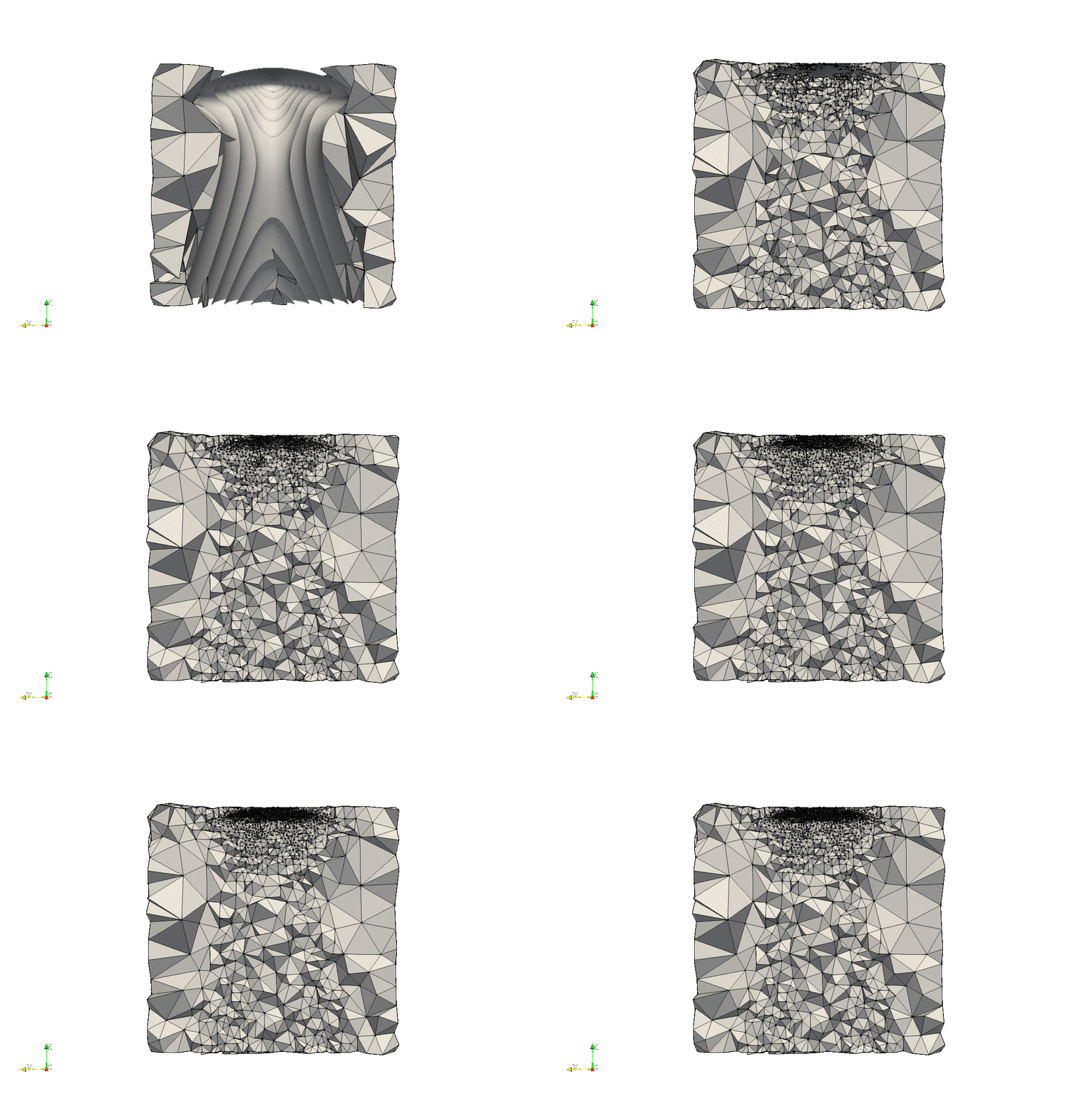
- Animated Process:
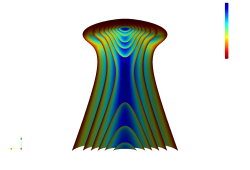
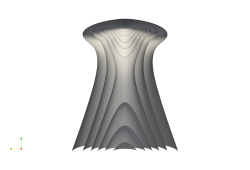
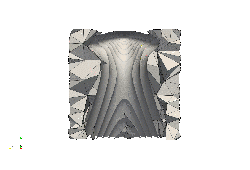
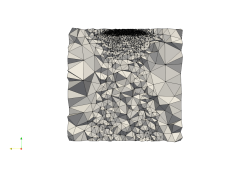
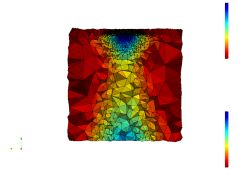 ✔
- The 3rd Image is a gif, which is visible here: https://crtc.cs.odu.edu/images/8/89/AdaptiveMeshing.gif
- Identify places in the code where δ varies with regards to background values
- Test if multiple δ work using synthetically generated image data