Isotropic Mesh Generation: Difference between revisions

From crtc.cs.odu.edu
Jump to navigation Jump to search
Kgarner (talk | contribs)
Line 18: Line 18:


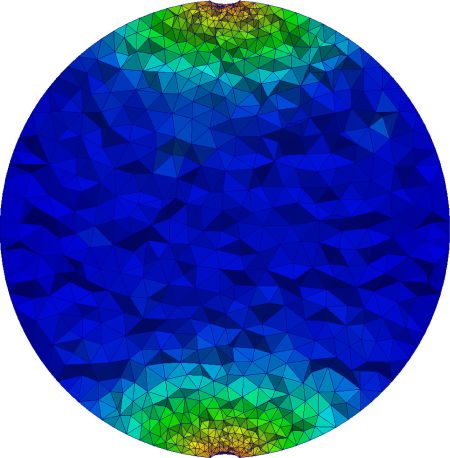
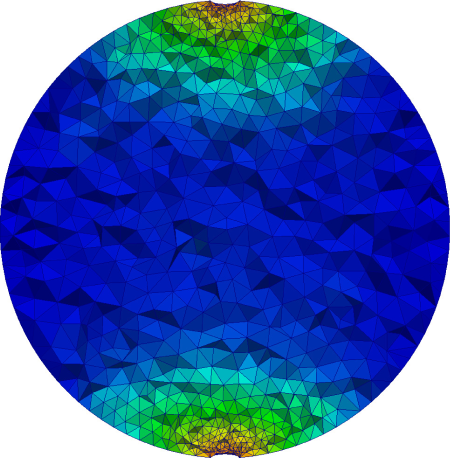
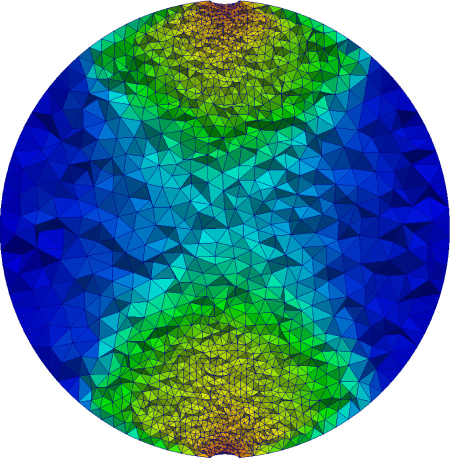
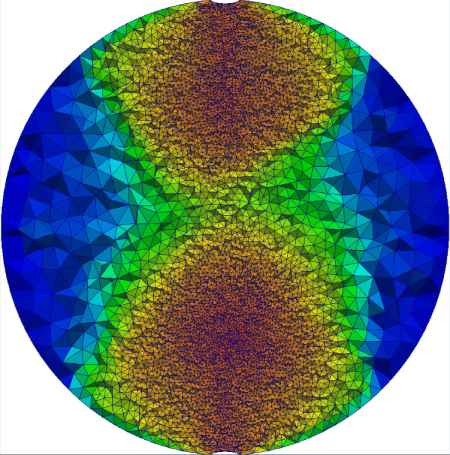
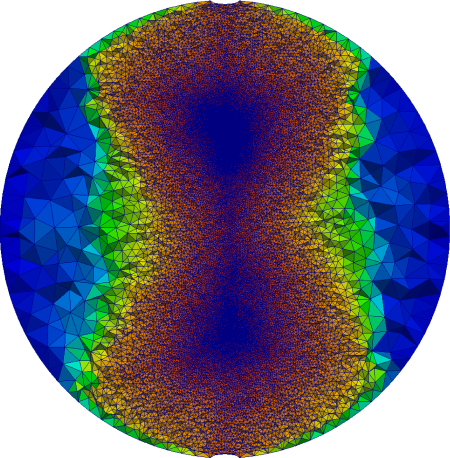
Cuts of tetrahedral grids of a sphere generated for varied cdfm ∈ [0, 1]. Blue
corresponds to larger values of the distribution function. Red corresponds to smaller values
corresponds to larger values of the distribution function. Red corresponds to smaller values<br>
of the distribution function.
<br><br><br><br><br><br>
Line 39: Line 39:
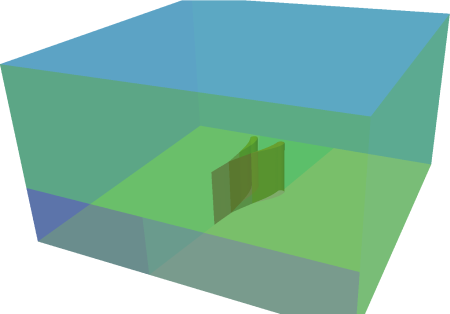
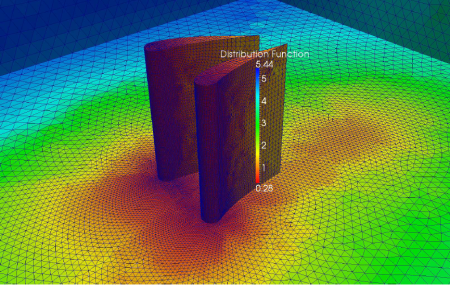
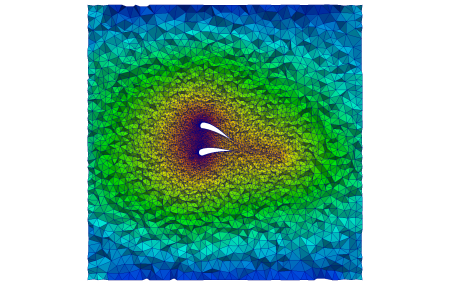
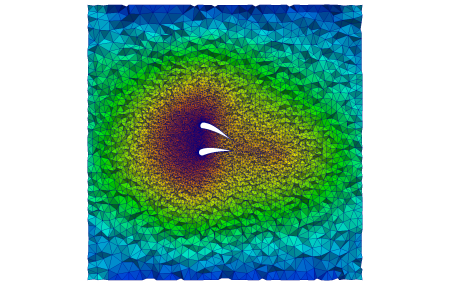
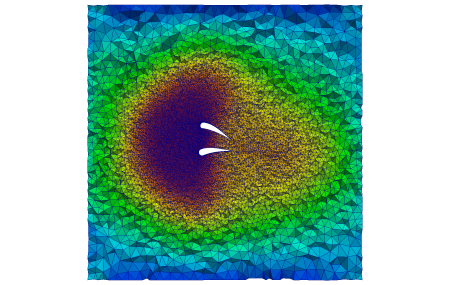
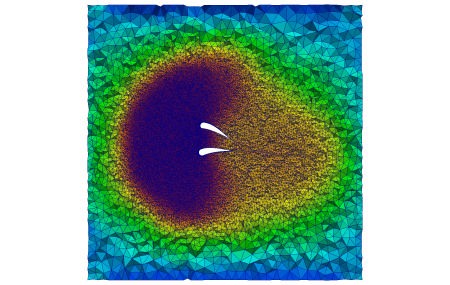
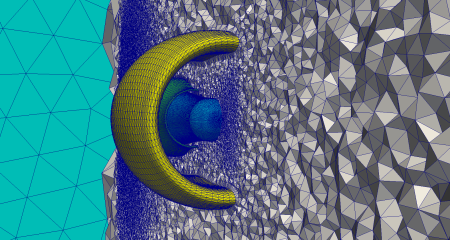
Cuts of tetrahedral grids of two blades with merging wakes and a symmetry
plane enclosed in an outer boundary generated for varied cdfm ∈ [0, 1] (shown in
(c)-(f)). The input surface is depicted in (a)-(b). The wake region is modeled as an embedded/
(c)-(f)). <br>The input surface is depicted in (a)-(b). The wake region is modeled as an embedded/
transparent delete surface.
<br><br><br><br><br><br>
<div><ul>
<li style="display: inline-block;"> [[File: sphere_histogram.png|thumb|none|2000px]] </li>
</ul></div>
Element angle distribution (in 5-deg increments) of grids of sphere, for varied
cdfm.<br> The dihedral angle extrema and the element count are reported for each grid.
<div><ul>
<li style="display: inline-block;"> [[File: blades_histogram.png|thumb|none|2000px]] </li>
</ul></div>
Element angle distribution (in 5-deg increments) of grids of two blades with<br>
merging wakes and a symmetry plane enclosed in an outer boundary, for varied cdfm. <br>The
dihedral angle extrema and the element count are reported for each grid.


== nacelle, rocket, and lv2b pg. 122-124 ==

Revision as of 07:10, 27 March 2018

sphere and two blade wake sym pg. 118-120

  • (a) Input Surface
  • (b) cdfm: 0; #tets: 57K
  • (c) cdfm: 0.2; #tets: 58K
  • (d) cdfm: 0.6; #tets: 129K
  • (e) cdfm: 0.8; #tets: 854K
  • (f) cdfm: 0.9; #tets: 7.68M

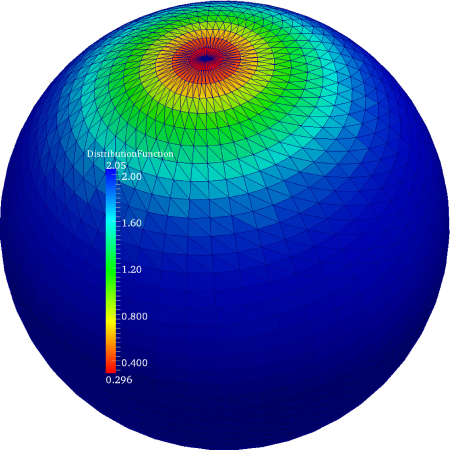
Cuts of tetrahedral grids of a sphere generated for varied cdfm ∈ [0, 1]. Blue corresponds to larger values of the distribution function. Red corresponds to smaller values
of the distribution function.


  • (a) Input Surface
  • (b) Distribution function on the boundary
  • (c) cdfm: 0; #tets: 806K
  • (d) cdfm: 0.1; #tets: 1.41M
  • (e) cdfm: 0.2; #tets: 4.97M
  • (f) cdfm: 0.3; #tets: 16.54M

Cuts of tetrahedral grids of two blades with merging wakes and a symmetry plane enclosed in an outer boundary generated for varied cdfm ∈ [0, 1] (shown in (c)-(f)).
The input surface is depicted in (a)-(b). The wake region is modeled as an embedded/ transparent delete surface.


Element angle distribution (in 5-deg increments) of grids of sphere, for varied cdfm.
The dihedral angle extrema and the element count are reported for each grid.

Element angle distribution (in 5-deg increments) of grids of two blades with
merging wakes and a symmetry plane enclosed in an outer boundary, for varied cdfm.
The dihedral angle extrema and the element count are reported for each grid.
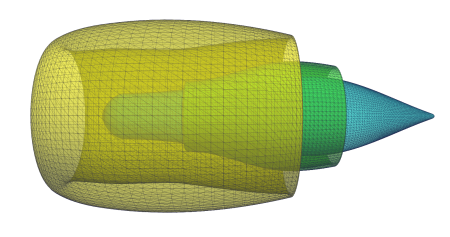
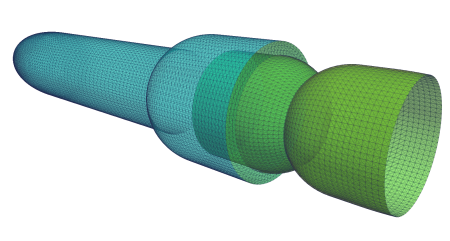
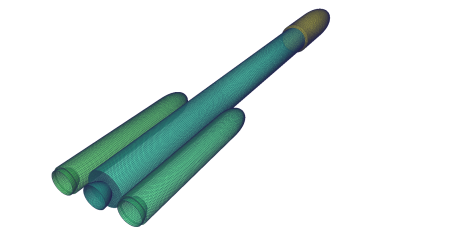
nacelle, rocket, and lv2b pg. 122-124

  • PLACEHOLDER
  • PLACEHOLDER
  • PLACEHOLDER
  • PLACEHOLDER
  • PLACEHOLDER
  • PLACEHOLDER
  • PLACEHOLDER

more nacelle, rocket, and lv2b pg. 125-127

  • PLACEHOLDER
  • PLACEHOLDER

aircraft pg. 140-142