CNF:CNF Adaptivity: Difference between revisions
Spyridon97 (talk | contribs) m Spyridon97 moved page Adaptivity to CNF Adaptivity |
Spyridon97 (talk | contribs) m Spyridon97 moved page CNF Adaptivity to Internal:CNF Adaptivity |
(No difference)
| |
Revision as of 15:09, 30 April 2020
Introduction
In [9], the CRTC developed PODM, which is a parallel Image to Mesh conversion algorithm with quality and fidelity guarantees. Using PODM, JLab acquired the ability to convert their phase-space distribution images to meshes and then utilize them for Monte Carlo Simulations. Nonetheless, JLab requested that their phase-space distribution images should be converted to adaptive meshes, which means adapting the tessellation procedure to the n-dimensional features of their distribution.
In [10], CERN dealt with an equivalent problem and developed a general-purpose, self-adapting Monte Carlo (MC) event generator (simulator) Foam algorithm. Leveraging this algorithm, the CRTC developed an algorithm to support adaptive tessellation in N-D with user-defined parameters (minimum element size, element weight limit) and integrated it into its Mesh Generators, Tesselate 2D and PODM 3D. Similarly, this algorithm is separated into two stages. The first stage is the initialization of the adaptive function which in a sense extracts the n-dimensional features of the distribution image and saves its attributes. The second and most crucial stage is the check if the adaptive function needs to be applied to a specific element, and only then the element is split. First, it computes the necessary parameters of the geometry of the element, and then, if it meets those and user-defined parameters, the element is split. The check of the adaptive function is made if and only if the tested element meets all the Delaunay refinement rules of its Mesh Generator.
Algorithm

Results
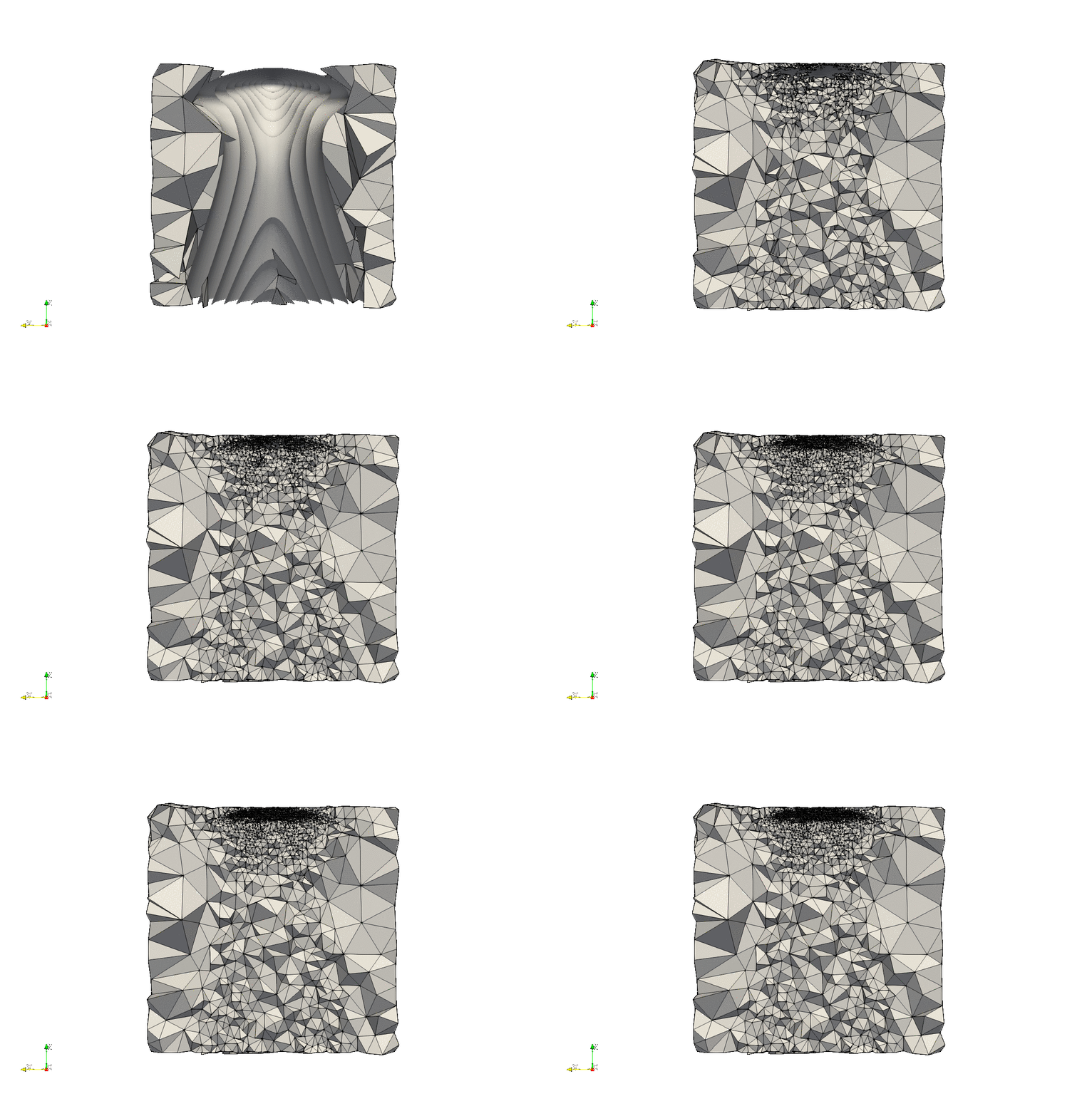
- Podm Result of Gagic Data image with volume grading on and δ=6, minimum Volume Size = 0.5, limit = 0.1✔
- 2D (Triangle):
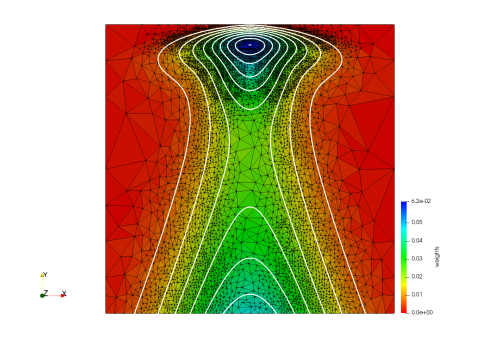 (Done by Christos)
- 3D (PODM):
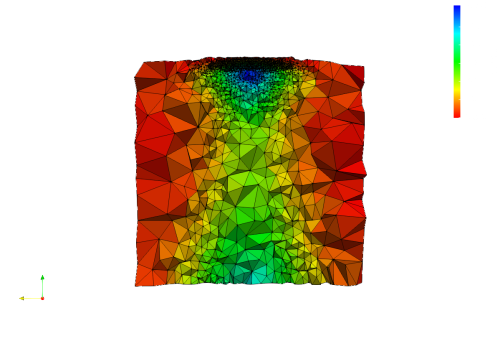 (Done with Christos)
- 2D (Triangle):
- Produce an Animated Adaptive Procedure video http://www.cs.odu.edu/crtc/videos/PODM3D.html ✔
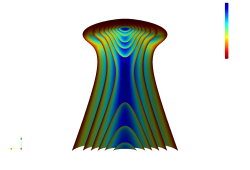 -> Input Image:
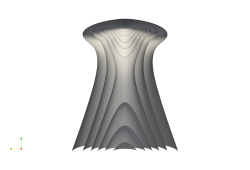 -> Image Segmentation
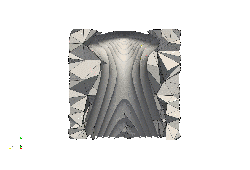 -> Meshing Procedure. This is a gif which is visible here: https://crtc.cs.odu.edu/images/8/89/AdaptiveMeshing.gif
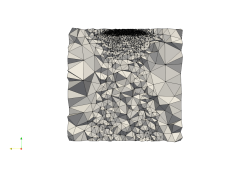 -> Adapted mesh
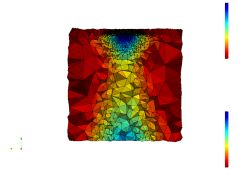 -> Linear Interpolation