Internal:SlicerExtensions: Difference between revisions
| Line 13: | Line 13: | ||
== APBNRR Extension == | == APBNRR Extension == | ||
Status: <span style="color: | Status: <span style="color:blue">DESIGNING</span> | ||
Due to the conflict of ITKDev and the ITK version of Slicer, creating a locally executable APBNRR module for Slicer is not conventionally possible. | |||
But I have figured out another way to do this. I will create a scriptable Python module for Slicer that will act as an intermediary between a portable (that statically links all dependencies) pre-compiled APBNRR executable. This will create the illusion that the user actually uses a traditional external module, which is not the case. The intermediary module will pass around data between the APBNRR executable and Slicer, and because of the deep integration of the Python environment with Slicer, I can instantly display results, similarly to a standard external module. | |||
The | The skeleton of the intermediary module can also be used for the remote execution module, modified to communicate via SSH. | ||
=== Checklist === | === Checklist === | ||
* | * Create pre-compiled portable APBNRR executable. | ||
* | * Implement intermediary "executor" Python scriptable module in Slicer for local execution of APBNRR | ||
* Implement | ** Design U/I | ||
* | ** Implement logic | ||
* | * Implement intermediary "executor" Python scriptable module in Slicer for remote execution of APBNRR and parameter optimization (reuse local module skeleton) | ||
** Design U/I | |||
** Implement logic | |||
Revision as of 22:45, 15 August 2018
PBNRR Extension
Repository: https://github.com/aangelos28/PBNRR
Status: UPLOADED
-
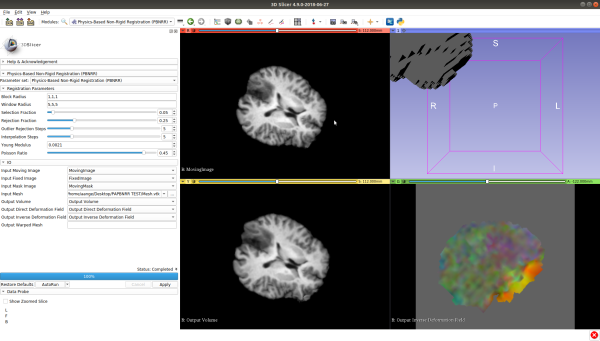
PBNRR running on the upcoming Slicer 4.9 release. -
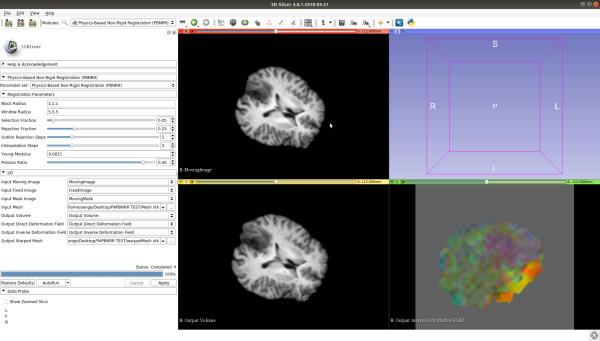
PBNRR running on the current Slicer 4.8.1 release (compiled with Qt 5 and VTK 9).


APBNRR Extension
Status: DESIGNING
Due to the conflict of ITKDev and the ITK version of Slicer, creating a locally executable APBNRR module for Slicer is not conventionally possible.
But I have figured out another way to do this. I will create a scriptable Python module for Slicer that will act as an intermediary between a portable (that statically links all dependencies) pre-compiled APBNRR executable. This will create the illusion that the user actually uses a traditional external module, which is not the case. The intermediary module will pass around data between the APBNRR executable and Slicer, and because of the deep integration of the Python environment with Slicer, I can instantly display results, similarly to a standard external module.
The skeleton of the intermediary module can also be used for the remote execution module, modified to communicate via SSH.
Checklist
- Create pre-compiled portable APBNRR executable.
- Implement intermediary "executor" Python scriptable module in Slicer for local execution of APBNRR
- Design U/I
- Implement logic
- Implement intermediary "executor" Python scriptable module in Slicer for remote execution of APBNRR and parameter optimization (reuse local module skeleton)
- Design U/I
- Implement logic